Level 4 Certificate · life-safety specialism
Firefighters’ and evacuation lifts.
Specialist training covering the identification, examination and testing of lifts intended for firefighter use or evacuation. A life-safety specialism.
- Covers firefighters’ lifts and evacuation lifts
- Seven units, including both testing and commissioning
- Workplace-assessed, portfolio-based
Not sure this is the right one? Tell us what you do and we will say so.
The qualification
Level 4 Certificate in Identification, Examination and Testing of Lifts for use by Firefighters and/or for Evacuation
| Qualification | Level 4 Certificate in Identification, Examination and Testing of Lifts for use by Firefighters and/or for Evacuation |
|---|---|
| Duration | 24 months |
| Price | Ask us — not currently listed |
| Units | Seven units |
| Delivery | Online learning, assessed in your own workplace |
Who is it for
Engineers on life-safety installations
You examine or test lifts designated for firefighter use or evacuation.
Duty holders and responsible persons
You are accountable for these installations and need the training documented.
Employers
You hold contracts covering firefighters’ or evacuation lifts.
What it includes
Seven units. Every unit is evidenced from your own work.
| # | Module |
|---|---|
| 1 | Understanding health and safety requirements in the lift and escalator industry |
| 2 | Meeting the requirements of health and safety within the lift and escalator industry |
| 3 | Obtain, evaluate and report on data and information in the lift and escalator industry |
| 4 | Make decisions by exchanging information with others in the lift and escalator industry |
| 5 | Performing commissioning tests on new equipment in the lift and escalator industry |
| 6 | Lifts for use by Firefighters or for Evacuation |
| 7 | Performing testing operations on existing/modernised equipment in the lift and escalator industry (optional unit) |
How it is assessed
- Delivered as online learning you work through at your own pace, around shifts rather than instead of them.
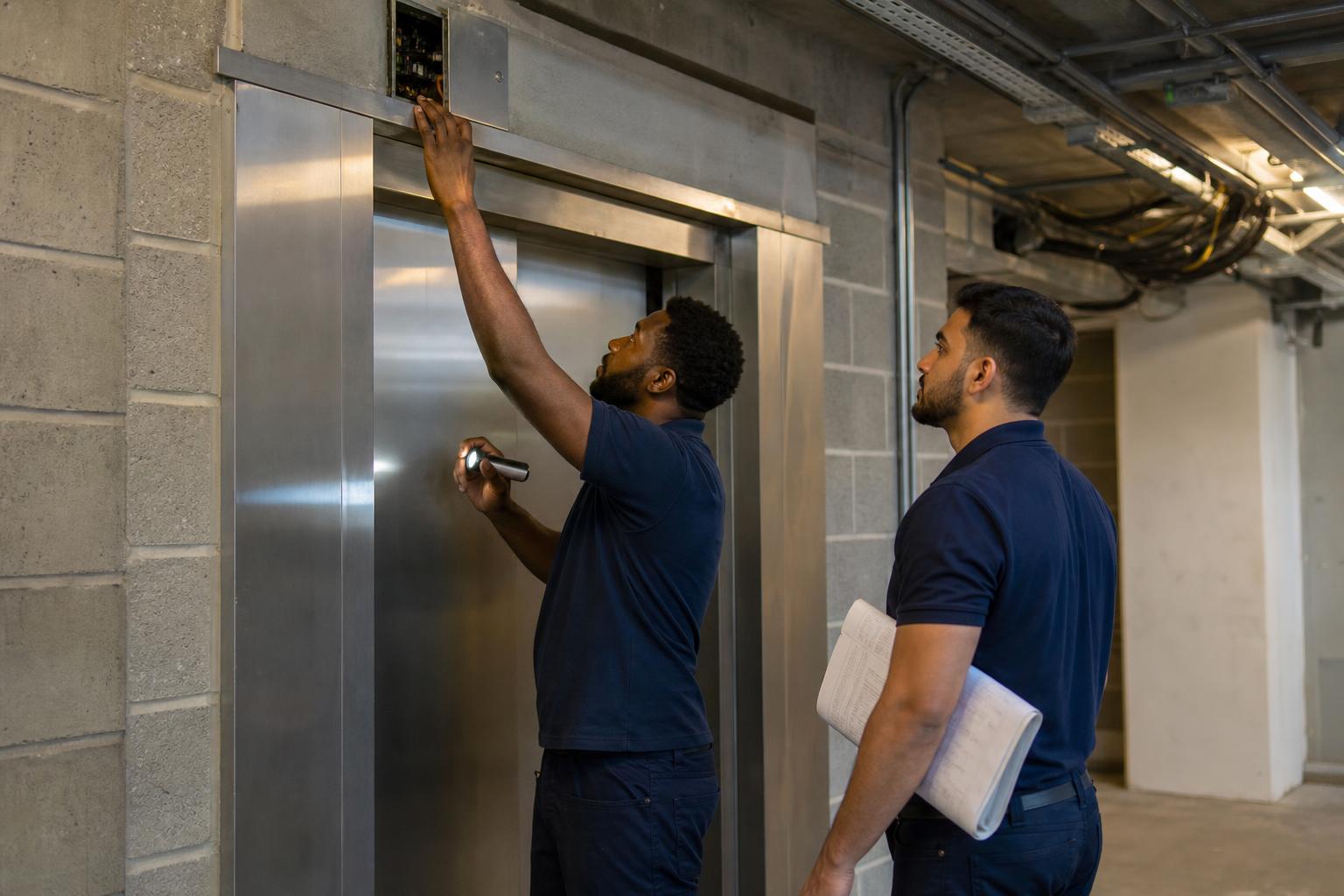
- Built to be evidenced at your normal place of work, on real jobs — not through classroom exercises.
- Your assessor observes you working, and talks through what you did and why.
- Everything is recorded in a portfolio you keep.
- Written and delivered by people who have done the job.
What you end up with
- A complete portfolio of evidence drawn from your own work
- Structured training written specifically for this equipment, not adapted from general engineering
- No classroom time, and no fixed end date
- A clear record of what you can do, ready for the day it needs to be assessed formally
Before you ask
Questions we get a lot
Where does the training happen?
The learning is online, worked through at your own pace. The practice is your own work — this is built around real jobs rather than classroom exercises.
How long does it take?
There is no fixed end date. It depends how quickly you work through the modules, and most people fit it around live jobs.
Do I have to attend anything?
No classroom attendance.
Who writes the training?
People who have done the job. Every module is written for lifts and escalators specifically — not general engineering with a lift example added.
Can I do this as a team?
Yes. Tell us roughly how many people and when, and we will come back the same working day.
Next step
Get prices and the next available dates
Tell us what you need and we will come back the same working day.
- No obligation, and no hard sell
- We’ll tell you if this is not the right qualification for you
Other courses
Not quite what you needed?
NVQ Level 3 — Lift Repair
Structured training for engineers working on lift repair, assessed on the job.
NVQ Level 3 — Escalators
The same programme, built around escalator service and repair.
Level 4 — Testing
Advanced training for testing existing and modernised equipment.
Level 4 — Commissioning
Advanced training for commissioning new installations.